Showing posts with label Christianity. Show all posts

Saturday, September 03, 2011

Mill Avenue Nights: Friday, September 2nd 2011

Where Mill Avenue gets a visit from The Door and I speak to one of their parishioners

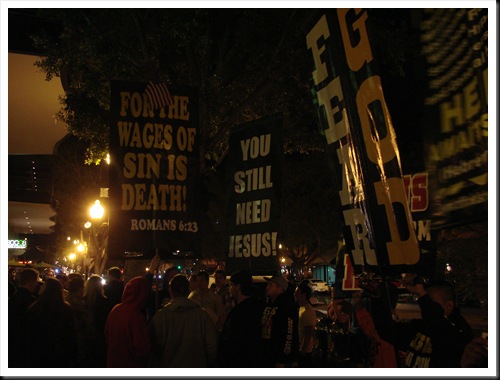
Upon arriving on the Ave, Arienne and I noticed a group out in front of the Post Office singing and carrying about signs. The signs contained mostly Christian propaganda messages that included references to “Jesus” and “blood” and other common metaphorical elements of the Christian doctrine. They had amplification and seemed to have an almost-band set up. I didn’t recognize them, so I wanted to go over and check them out.

It took us about ten minutes to make it from our parking spot back to the Ave.

After reaching them, I broke out my voice recorder and my anthropology journal and started taking notes, positioning myself on the other side of the newspaper kiosk wall.

A woman approached Arienne to offer her some literature and speak with her. The woman immediately after handing over a few tracts started speaking about the Christian religion and asking if we (mostly Arienne, as I was engrossed in my notes) knew about Jesus Christ and his activities—insert the usual Christian religious doctrinal spiel here. What I didn’t know at the time was that the woman had handed Arienne a tract identifying her as being part of The Door.

The Door is a cultish Christian group with a community church not far from Mill Ave who have been indicted in numerous bad behaviors on the Ave. They have in the past created violent outbursts during Halloween, interfered with the Mill Avenue Resistance’s amplification equipment (pulling Kazz’s microphone cord and holding it), and lied to the police about their activity after calling them on the Resistance after ostensively committing simple assault.

As a result, Arienne turtled and didn’t speak to the woman except to nod her head and smile; absorbed in my work, I didn’t realize she didn’t speak to the woman at all and the woman probably felt somewhat ignored. I probably should have had a talk with her instead, but I needed to get my notes down. Of the literature I received, one is a glossy, two-sided color advertisement for The Door Christian Fellowship Church on Broadway; the other two are Chick tracts: “HI THERE!” and “THIS WAS YOUR LIFE!”

Questioning Arienne about the events and why she didn’t speak to anyone, she confided that she didn’t want to speak to anyone from The Door because of their reputation of bringing violence and tension to the Ave. She also expressed that even though she’s a Christian, she belongs to an enemy faction to The Door and didn’t want to accidentally give that information away (once again noting fear of their bad reputation.)

A gender switch and a different parishioner decides to come talk to us

After the woman left, she was quickly replaced by a male, who immediately asked me about why I was taking notes.

(I believe he introduced himself as Tim, but I didn’t catch his name; neither did Arienne.)

I told him that I take notes about Mill and that preachers feature in the notes because they appear on Mill. He asked, “What’s wrong with that?” referring the preaching. Of course, there’s nothing wrong with the preaching per se. I explained that I study Mill Avenue as an anthropologist and I write fiction—I gave him a card for Mill Avenue Vexations—and forgot that I’m even wearing my Mill Ave T-shirt.

At first he asked questions about my religious experience and attitudes and I attempted to explain Celtic paganism to him. He elaborated that he, “Teaches other people about other religions and it helps if he understands them so that he can explain them.” Tim must be a terrible teacher because instead of listening to what other people have to say, he projects his own biases onto them and constructs entire scarecrow populations of strawmen in reply.

He asked about afterlife beliefs, I tried to explain the Otherworld.

He asked about morality and code of conduct and I explained the social construct of moral codes, harm, entitlement, and social contracts. He eventually went on to ask me about what pagans felt about “killing children…and other sins and immorality like abortion, homosexuality, sex before marriage…” I don’t know why he started out by asking about where pagans stand on “killing children” it made absolutely no sense and he quickly distanced himself from it.

We had a very brief exchange that sin is meaningless to people outside of his culture who don’t accept the concept of a divine command or divine law. Since “sex outside of marriage” came up last in his list I noted that pagans don’t care. Marriage is not a social construct that most pagans believe has any necessity with sexuality; furthermore, sexuality is something that we as a culture have developed numerous technologies to make safe and good for everyone and it’s proper that we educated ourselves and used that technology.

Tim tried to point out that nobody listens and I noted that’s because proponents of the “abstinence only” and “no sex before marriage” are deliberately miseducating and not educating people. I likened it to gun-control proponents giving out guns then deliberately not educating anyone or miseducating them; and then pointing out how dangerous guns are in the hands of neophytes as a reason to ban them (actual advocates don’t want people miseducated.) Since I don’t find “divine command” to be more important than actual harm I pointed out that his assertions would have to be backed up with more than just an argument from irresponsibility.

Noting that I kept dismissing anything that happened to be a divine command and asked for evidence of harm, Tim decided to switch to a witnessing propaganda tactic where he started to talk about how he used to be very much like a pagan: “I used to be shooting up all the time and engaging in carnality of the flesh.”

I’d repeatedly had to tell him that I didn’t say anything about pagans encouraging debauchery and unsafe behavior, which he kept intimating I meant by saying that pagans couldn’t care less that YHVH commanded people to get married first. This had already been an ongoing problem in his replies. Every time I mentioned that pagans didn’t accept some restriction placed by his deity and/or culture, he would immediately reply as if I had said there were no limits altogether. I pointed out that he didn’t care what Zeus or Odin had to say on the subject either because he’s not Ancient Greek or Asatru; but that didn’t mean that simply because he didn’t accept one of their restrictions he was reckless on all matters.

Finally, he started to make bald statements about how he had the absolute truth and that I would have to submit to my creator. To which I replied, “My creator would be a female goddess; not your male YHVH like you keep claiming.”

He kept trying to tell me, “I’m just telling you what I believe, like you told me what you believe.” Except that he wasn’t telling me what he believed; he had skipped directly to telling me what I should believe. And he did so by advocating this divine authority that he kept attempting to place on me. This isn’t an exchange of beliefs. There wasn’t any “I believe” in his statements it had all become: “You will” and “you must.”

I explained to him that his propaganda isn’t convincing and that he had started using a technique called the mere messenger stratagem. This is where the propagandist claims to be a mere messenger for a greater authority to which the recipient has no way of corroborating or access to.

He went on that he didn’t intend to convince me.

I tried to explain that when a person starts telling me what I should believe that in fact they are trying to convince me, so why was he doing that if he didn’t want to convince me.

He followed that up with some statement that Jesus told them to “compel” people…

At which point I think he lost the plot, since compelling people is by its nature by force and good luck forcing anyone to believe anything. Belief doesn’t work that way unless it involve traumatic brain injury. Here I thought he’d just wanted to fall back on, “I’m just having a conversation, an exchange of beliefs,” but no, he either misunderstands the word “compel” or he’s actually out there to attempt to force people to convert.

At this point, Tim noticed that the parishioner group of The Door had vacated the Post Office about ten minutes earlier.

He hastily excused himself.

The Door and their bad reputation

The Door’s well-deserved bad reputation for their intimidating and brutish behavior on Mill Ave has really made an impact on some of the people who visit. The fact that another Christian, Arienne, finds to cause grave concern deeply worries me. While I would like her to be able to speak to anyone who comes to Mill, I am not sure I am not about to press people into interacting with them.

She has rightfully pointed out that she doesn’t want to encourage them. They have, after all, made themselves a dangerous influence on the Ave and if they should wonder why people are treating them like wild animals don’t need to go far to discover that they’ve done it to themselves.

Sunday, August 07, 2011

Mill Avenue Nights: Saturday, August 6th 2011

A few nights now, there have been drummers set up in front of the Post Office and that had displaced the evangelical preachers across the street. However, this evening there were no drummers and thus they set up in front of the post office.

We saw a few of the usual folks standing around, including Marcus,

That’s when Arienne and I were approached by an older gentleman of notable more than average height. He attempted to offer Arienne a Way of the Master fake-money tract depicting President Cleveland. (Of course, after I got home and examined the tract, I discovered it’s in Spanish.) After introductions, we learned that his name was Ken.

Like most of the Way of the Master evangelicals his approach is decidedly deep in the propaganda training than it was much personality. It took me a while to determine that this was his first time on Mill Ave and that he’d come to the Ave with the other evangelicals after meeting Tom.

He spent some time using a lot of different elements of propaganda on me and even held a long conversation with Arienne. He seemed a little bit ignorant of the history of his religion but has spoken about tightening up on his understanding of the lack of historical evidence for mythological characters like Jesus (even going so far to repeat a common canard that suggests that there’s more evidence for Jesus than Abraham Lincoln. A slogan that’s as patently false as absurd.)

After many minutes of absorbing his knowledge of Way of the Master propaganda, and letting Arienne converse with him, I decided to see if I could speak to him as a person. As he was new to Mill Ave, he seemed pretty zealous about selling his viewpoint; but none of it is anything that anyone extracultural would want to buy. As Arienne actually belongs to his religion, I figured that I’d best observe his interaction with her to get a baseline, especially if all I was going to get happened to be mirror-speak.

Eventually, something unexpected happened and Ken started talking to Omni (the Reverend Übermensch Omnicynic) and that conversation became interesting. Not a person to sit down in front of a challenge, Omni cultivated a discussion of Christian mythology that painted YHVH as an ineffective deity who fled in the face of rivals and needed his followers to do everything for him. I couldn’t quite follow along with everything discussed; but I did hear Omni speak about much of the comparative mythology.

After some lively discussion, Omni tired, claiming that Ken had begun to repeat himself. He quit both the conversation and the Ave at that point.

Eventually, however, after Crystal arrived on the scene Ken actually sat down with us and held a much more personal conversation bereft of the propaganda that advanced a personal dialogue. We ended up in a rather lively conversation about the origin of birthmarks, freckles, and the pigment mutation in recent European ethnic descent that causes us to have much lighter skin tone than African ethnicities. The conversation wound on to discussing aberrant psychology such as schizophrenia and Dissociative Identity Disorder.

Ken revealed to us that a relative worked in a mental hospital and spoke a little bit about the diagnosis of Asperger’s syndrome patients and its apparent prevalence in the population. Elaine Mercer from Black Hat Magick exhibits some of the spectrum of Asperger’s syndrome—as similar and fantasized about in the geek community—but even these examples don’t well reflect the reality of the condition.

I enjoyed the time I got to actually sit and speak with Ken as another person. I don’t know that I can adequately approach his cultural propaganda; he lacked the apparent cynicism and paternalistic simpering of many of the other preachers who speak down to passersby and could actually be an asset to the culture of the Ave.

Chicago Still on Mill Ave

Glad to see that Chicago is still bringing his interesting bottle-tab outfit out to the Avenue. He’s laconic, but smiling black neo-punk who fashioned his wardrobe out of metal bits and bottle-tabs; the effect produces a chainmail armor and coif effect as it’s a hoodie, a shirt, and a pair of pants.

When I hit the bricks, I often find him sitting near the clock.

Don’t Know Where I’ll be in a Month

I’ll miss the Ave the most.

Sunday, November 14, 2010

Mill Avenue Nights: Saturday, November 13th 2010

Mill Avenue had a strange visit today from a belligerent set of street preachers led by Ruben Israel.

Ruben Israel 016 Amid his group, Israel brought five extremely well-girthed men, five large plastic signs, and one bullhorn. They stopped in front of the popular Mill Ave bar the Mill Cue Club—a place where other preachers have done a similar thing—the major exception, however, is that Israel’s crew are actively abrasive. The men with Israel used a particular tactic of insulting first and then asking questions later, they would pick elements on a persons clothing, their attitude, or racial features and throw epithets and slurs to gain attention.

Marcus Mattingly, one of the proper Mill Ave Christian street preachers, describes Ruben Israel as a heretic and people shouldn’t listen to him anyway. The presence of the new preachers and their signs did not affect the major Mill Ave preachers at all. The crowds did start to clutter around the Mill Cue Club, but it didn’t draw attention from the street preachers nor did it cause them any frustration. Other than a few shrugged shoulders and rolled eyes, thus was the entirety of Israel’s impact.

The Mill Avenue Resistance, in the persons of Gadfly and Kazz, quit their usual position protesting the usual street preachers and moved next to Israel and his crew in front of the Mill Cue Club.

Instead of putting up any sort of rational discussion or civil conversation, Israel and his posse only spat back insults and vituperations. Responses consisted primarily of non sequitur nonsense, abuse, racial slurs, and political insults. Gadfly brought the brunt of the attacks with her femininity being called into question and other hyper-misogynistic speech. Kazz was met with name-calling about his appearance every time he spoke, being called a hippy and branded as effeminate. These men obviously have massive problems with women—it certainly explains why there wasn’t a single woman among them.

Ruben Israel 006 “Please don’t put that girl on again,” whined one of the preachers over his bullhorn. “She’s annoying.”

Passersby also absorbed some abuse from them as they tried to shout over the noise from within the bar.

Mostly they would stop random people and call them “gay” as if that were actually an insult.

When I attempted to stop Rube Israel himself to ask him who he was with and what they were doing he chose to insult me ineffectually. At one point he called me out for not being able to read his sign even though I wear spectacles (wouldn’t that be why I’m wearing spectacles?) The address of his web page, whilst visible on the signs, was printed over the point where the pole inserts into the sign itself and thus made it difficult to make out. He also casually claimed that I was a Satanist. Not that I am, nor is that really much of an insult either, but he used it with the same role as their attention grabbing insults.

There wasn’t much of any substance to Ruben Israel’s circus act.

Monday, November 01, 2010

Mill Ave encounter with The Door on Hallowse’en

Mill Ave Halloween 007

This post entails an anecdotal narrative about an experience on Mill Ave, Hallowse’en 2010, involving a Christian congregation called The Door. There have been previous problems with them and their behavior on Mill Ave; but this year they managed to comport themselves mildly and without too much friction.

The first man to approach us from The Door zeroed in on me and immediately said, "I just wanted to let you know that Jesus loves you." He said this over-and-over as if I were failing the proper social reply. He was a small Latino man, the orbits of his eyes set further apart than is normal, but his face appeared round that gave him a sort of intense effect. He'd cropped his dark hair short against his skull and wore jeans and a collared shirt. I never even got his name during the entire discussion, but I did attempt to steer the conversation away from culture shock, but he felt rather committed to the hard sell.

"Thank you," I said, thinking that the "Jesus loves you," meme is generally a sort of blessing that Christians use (especially this evangelical type) to connect with the other person; however, that didn't do it for him. He quickly went on into his mirror speech, something that probably fits the jargon term "witness statement." Such as cliché to these statements he starts talking about how he used to live a self-destructive life, he did drugs (marijuana), drank alcohol, and partied all the time. And, now that's all changed.

Ostensively he would have attributed this change to his conversion to a particular religion. I am not certain what sect of Christianity that the Door belongs to, but it's probably theirs he would espouse.

His mirror speech followed script extremely well as he passed onto the question, "If you were to die, where would you go right now?"

And, as I like to work from Celtic mythology, as is my heritage, I said, "Well, the Otherworld."

He immediately went on to talk about Christian mythology, including about how they propose that when people die they'll be judged and then be sent to one of two places: Heaven or Hell. Here his mirror speech failed him for a moment as he ran into someone to whom these two terms create a sense of culture shock. So he attempted one of the worst metaphors I have ever heard on the subject,

"What do you see right there? In the street," he asks. Well, it's a street and it has cars driving in it. "What would happen if you tried to drive the wrong way down that street?" Well, you'd collide head on into another car. "After you die there's only two directions you can go."

That's not what the rest of the world thinks and it's certainly not related to any knowable reality (i.e. Heaven, Hell, the Otherworld, Xibalba, etc. aren't demonstrable so pretending they are is just stupid.) So I said, "No they're not..." I didn't get a chance to go on that every culture that has ever lived as invented itself afterlives of different sorts, from heavens, to hells, to happy hunting grounds, to the dwelling abode of the gods. There are near infinite and myriad answers to that question and not a single one of them can be tested (although some of them are logically absurd) so I have no reason to accept his assertion over any other.

Then he said something actually interesting and mentioned that The Door had a visiting preacher who had gone to Romania. I asked if the preacher himself was Romanian, no he wasn't, but his wife was.

Anyone who doesn't know, but there's a famous critter on YouTUBE, ZOMGitsCriss who also lives in Romania. So I'd be interested to see what she thinks about some of these subjects, but I have no reason to bother her.

Finally, our conversation ended when said missionary from Romania appeared.

He was a large man, almost taller than me—in fact loomed over me because I stood in the street and he stood up on the curb--square spectacles, broad shoulders bearing a plaid shirt, and dress slacks. His hair, dark from its appearance, buzz cut into a flat top. He carried with him a Bible that his hands dwarfed and introduced himself as John. When he spoke he delivered his mildly accented Midwestern words with a cheerful bombast that grew on his face and I could hear the slight pull of another language in some of his words (knowing that Romanian is a Romance language gave me some insight into some of the pronunciation changes, but I could have been supplying that through my own bias.) In all, John's ability to cover a full range of language and answer questions made him an interesting foil to the Latino man who had originally approached me.

I should point out that because he's a visiting missionary he's not connected to The Door or their cultish behavior directly and he's probably using them to help score himself money for his missions in Romania. This would readily explain why it felt like a totally different level of discussion talking to him rather than the Latino man who never gave me his name.

250px-BOR_CoA His experience in and of Romania really intrigued me. He mentions that Romania is primarily Eastern Orthodox (probably under the auspices of the Romanian Orthodox Church, Wikipedia gives the stat as 87%.) If John is working with The Door, I suspect this means that his sect is Protestant, which means that he'll face a certain amount of resistance from the local culture. He mentioned also that he had three mission churches erected in Romania—specifically in the Transylvania section, a huge chunk of the north western region.

He also went on to say that treatment of women in Romania is next to the most ugly, citing that they're second highest in the world for lack of women's rights; also that Romania is second highest in the world for abortions. He mentions there is no 911 service and that he continually hears crying and weeping where he lives in a multistory apartment building of women and children pleading not to be beaten. (I have no way of verifying these anecdotes or statistics, so I invite Romanian citizens and scholars to opine.)

I enjoyed speaking to him, but didn't get a chance for a full interview of his experience. He had to leave too early for that.

Welcome to Mill Ave, John. Just, next time choose a better congregation to spend time with.

Sunday, November 23, 2008

Mill Avenue Nights Saturday November 22st 2008

Some interesting things to regale people with tonight. The SFTS invited some reporters from the New Times to observe what they do so I saw them out there with the group, but didn’t get much of a chance to speak with them; I’m not quite sure that journalists are in my observative mandate for Mill Ave. Of course, I’m happy to see them checking out things on the Ave.

Upon arrival we discovered a huge protest happening on the corner of Mill Ave and University—prominent in the group were flags that were immediately obvious as Palestinian. It seems that there was a protest that night that went as late as 8pm by a Palestinian group about Israel. I did not get a chance to talk to them, nor get photographs (my camera died covering the Westboro no-show.)

“End Israeli Occupation”

Drum Circle and Mill rats

Amid the crowds I found Vince wandering around, but didn’t have a chance to speak with him.

The drum circle I missed out on in a major way, having trouble walking long distances. I accidentally dropped it out of my patrol path in order to shorten my movements. I did see a number of street rats that I know and spoke with them for a while, but I didn’t witness any drums—except for as musicians on the Ave itself—during the night.

I did have some conversations with random Mill goers who appeared to be middle-class Americans. Surprised by my makeup and the way that I dress (the whole goth thing has fallen a bit out of the public mindset recent.) I did not get his name but he seemed to be interested in my observations of the construction of the Centerpoint Towers and the other issues with real estate and Mill Ave nightlife.

Anthropology

I actually had a pair of extremely polite black American women approach me to ask what an anthropologist is. A thing that came up a couple times at the Westboro non-protest at The Laramie Project play showing at Glendale Community College. The term isn’t well known to the public—although there is a TV show which exemplifies it in a pop cultural way: Bones. It was fun to talk to them because they were cut-out of the flesh of Ave passersby themselves.

I have been waiting for people to say things like, “You dress funny for an anthropologist.” Whereas I would like to explain to them that when studying the savages it’s best to dress like them, but somehow I think that the humor might get lost on them. So I’ve kept that one on the back of my tongue for a more appreciative audience.

Preachers

The entire group of the SFTS clustered in front of Borders at about 8:30pm and eventually decided to move away because there was nothing going on. They finalized their set up in front of the Post Office where they pretty much spent the night.

Suzanne is the newest member of the Way of the Master group who I have met. She is a middle-aged woman with long, brown hair and a gentle voice. She had a sensibility that I don’t notice much in the preachers, but she wasn’t one of the shouty-shouty types and lent herself primarily to handing out tracts. She is the mother of the young woman in the wheelchair who comes out to Mill (who I haven’t had a chance to speak to yet—I’ve been spending too much time learning the names of the new Mill rats.)

Apparently her daughter is also a writer who has been working on archaeological fiction—a genre dear to my heart ever since watching all of Raiders of the Lost Arc and similar movies.

The next evangelist that I got a chance to speak with was Trevor. A middle-height young man, with short-cut hair, and a steady gaze like he’s looking for something behind your head. I spoke to him for a little while, trying to gage his gesticulations and body language with how he held his Bible. I also noticed that when he descends into his mirror-speech his voice “goes away” like it’s literally been lost in thought. I’m used to seeing people’s faces become blank or flatten, not their voices—in his case I think he’s way too well practiced with his mirrorspeech and this has created a different cadence to his voice when he falls back to a script.

I am slowly developing archetypes for the people who come out to Mill and he falls far, far away from Suzanne on that spectrum.

Usually I spend little time speaking, and I mostly listen when I meet a new preacher. But this time I felt a little impatient and decided to chisel at his mirrorspeech to get to know who he was as a person. Since he is really out there selling his religious meme, he had little time to actually do this sort of thing because I think he quickly discovered he wasn’t finding a convert in me (I’m too familiar with everything he had to say.) And more than once he missed entire sections of what I said because I must have hit a keyword in his speech that set off his script. Things like, “You must have a lot of faith then; a great deal.” In reply to things about Celtic mythology and how I find it extremely interesting.

He wouldn’t take one of my books, telling me, “That’s okay.”

Apparently he came to his particular doctrine from A.A. meetings. Which he described as false teachings, trying to tell people to either be their own god or develop their own sense of the divine in order to break themselves from addiction. He has a part-and-parcel indoctrination story about how he was steeped in party culture, getting drunk, doing some drugs and eventually dragged himself out.

He also had an obsession with “real names” like other evangelists of his particular type. I will go into why they do this in my post on Better Than Faith and in a later article on here. However, I have some observations and thoughts on it right below:

All names are real; or none are.

This is rhetorical, of course. When someone says, “real name,” they are attempting to apply some sort of disenfranchisement to a name that they don’t believe is what you like to be called by your friends. They feel like you have handed them a subordinate title because they’re not in the right group—and in fact, they’re right, they’re not in the proper group to know your name as you are with friends. Most our society affects this particular thing by offering our family name (last name) instead of our first name when introducing ourselves to strangers. In most cultures this is stratified by levels of formality.

The street, however, has a totally different take on this than the rarified polite culture: we have street names. And these names are as good as any, since they define and refine who and what we are to the people we meet there. These evangelists come into our culture and they experience a strange culture-shock when they discover that we are different than they are.

The general transcript of any conversation seem to run this way:

“What’s your birth name?”

“I don’t have it anymore.”

“What happened to it…?”

“I gave it back.”

“To who?”

“My parents.”

The misunderstanding at this point is where I derive a lot of amusement. The evangelists—or whomever—just really wants a “handle” on me by using the name they thing will have the most psychic impact on my mind, the psychology of names is that when people use them they tend to get our attention and notice. Really, I don’t have that name anymore. I don’t use it anywhere not even with the US Government. It’s not mine to give.

Worse: if Trevor used it, he would insult me over and over.

Have we ever thought about how naming someone who cannot choose their name themselves is a little bit silly? Naming a child nowadays is like naming a dog or a cat. Some creature that responds to a label by training, but not because they would have chosen it themselves. A great deal of people go by nicknames or names they’ve taken to themselves than birth names because often birth names are not even proper to the person—and then there are those who choose their birth names. In a way, accepting the gift; but this is not always the case.

He also had a strange comment about “true names.” Saying that if I were reborn (he must be from the Born Again meme) that his god would replace my heart of stone with a heart of flesh and give me my “True Name.” I don’t know what exactly he meant by that, except that it tells me that he himself doesn’t even understand what he originally meant by “real name” if I could get an entire other more proper “True” name by joining his mythology.

I am named after the daughter of one of the A’Toll Crystalian heroes: Amyrist Embrak A’Toll. One of the first of my clan, in fact.

You can read more about my observations of the preachers on my Better Than Faith observations blog post for this weekend.

Saturday, November 08, 2008

Mill Avenue Nights - Friday November 7th, 2008

Today I went to a meeting with the Secular Free Thought Society (SFTS) based at ASU to get a look at how they organize themselves. By in large the meeting was fairly boring, involving logistics and some internal maneuvering that needed to get done. What I did like was that there were visitors from a local Humanist group—three elders, two women and one man—who had things to say to the group about how they struck themselves out into the world.

Speeches were made as to the origins of Humanism and its dichotomy to religions. The Humanists are largely atheistic in their worldview, and seem to be politically active, by in large they described themselves as, “Old Hippies.”

The SFTS group (who would quickly be marauding) ate at Chilies because they hadn’t gotten food, I went to get the sights and sounds of the Ave—and found some evangelicals. I also stopped by and talked to Josh, my friend the chef, who wants to start a Voltaire Fanclub for Tempe because of the terrible showing at one of his concerts. Which I would wholeheartedly support should he get it off the ground.

I finally hit Mill at about 10:30pm and discovered a group of evangelicals passing out tracts. Mostly the tracts were the Million Dollar bills of the giant type and the tiny type. I counted four girls and one boy. A brief meeting and I learned some names.

First is Johnanna, a Latina girl who seemed to have an Azteca accent when she spoke English—and once said something in Español that I didn’t catch due to road noise—her American English is strong, but way too Harvard (which made it obvious she was ESL); her mirror-speech was unshatterable, I think because I couldn’t modify my argot simple enough to get points across. We spoke for a while and she pretty much just regurgitated lines of extremely common mirror-speech and I couldn’t get a word in. She has some interesting things to say, some self-depreciating language, but largely it would be nice to know what brought her to this life and why she’s on Mill Ave. Hopefully I can get a chance to speak to her as a person and not as a mirror.

Natalie (I could have her name wrong) who is a small girl, with a short haircut, and sciurdae features. Her presentation a bit more forceful that Johanna perhaps in that she’s a veteran of speaking to people. She tried, unsuccessfully, of course, to pull out Pascal’s Wager—except that she doesn’t realize that the Wager doesn’t work on people professing a different belief (like Paganism) it only works in the event of a dichotomy “there is a God; there is no God,” it becomes extremely meaningless when it’s between “there is the Christian God, YHVH, or there are the Children of Danu,” since then it becomes extremely easy to point out that it is therefore equally likely to be Amaterasu, Odhinn, or Huitzilopochtli—a blood-drinking hummingbird warrior god of the Aztecs.

Jonathan, who made himself the de-facto leader of the group using insular heteronormative social behaviors because he held himself as alpha-male and pretty much controlled the girls therefore—I will go more into this shortly. I had a discussion with him different than the others involving my name. I gave him my street name first, as is proper for speaking to people on Mill Ave; it’s an exotic name so he asked if it was my “real name.” A term which I find extremely amusing: all names are real. However, I believe he wanted to know if it was my common name—which it is not.

--

“Are you confused about your identity?” Johnathan said. His posture stiff, face open, but eyes roving as he spoke. His dress, simple but modest for the Avenue, consisted of a pair of brownish pants and a pale shirt, carefully ironed before he had buttoned it up. The entire time speaking to me he clutched a book—probably a Christian Bible—against his hip. Unsmiling, he awaited my reply.

“No, not really,” I said. “My identity on the street is simply a collection of social mores, protocols, and expectations that differ from other interactions. I don’t interact with people on the street the same as I do with say…the City of Tempe.”

“Don’t you feel like you live double life?”

“Heh. Double? If I thought about it that way I would have a thousand lives. I have a different identity to every group that I interact with. I behave differently talking to my bank, to my friends, to the street rats, at work, to the City of Tempe. I am probably just a lot more sensitive to it, I guess, because I study these things.

“I write. And in order to do a good job writers try to discover how people empathize, what faces and masks they wear. One of my favorite teachers, Father Prat, once told me that as I went further into writing I would eventually hit a point where I would start asking questions like: What makes people tick?

“And he’s right. How else do we writers create characters on the page that real, living, breathing people fall in love with? Empathize with? Cry with? I am essentially giving people who know real people a chance to find a connection with something totally imaginary.”

--

There was certain amount of almost overtly sexist heteronormative behavior on the part of this group as well. Something that we don't see a lot in the urban USA. An almost tribal sense of “you’re a woman; therefore you’re not as capable as men.” With the group that comes out on Saturday I saw this with Jerimiah who sometimes says, “Please don’t swear, there are ladies present,” and it’s obvious he doesn’t think about saying this because he’s said it to a woman before (talk about putting a foot in the mouth.) More than once I saw the single male acting as alpha, trying to herd the girls, constantly saying things like, “Just making sure the girls are alright,” and at least once telling them he was uncomfortable with them going off in a pair to get food.

This sort of behavior instills a wall between them and the rest of the community who don’t have this sort of outward expectation that women lack responsibility or capability. Especially on a busy street, surrounded by police officers, and various mundane watchful eyes. Certainly any individual alone may run a particular risk of danger from the drunken mobs, but this is an age of cell phones, and walking in groups/pairs, where it’s hard to get out of eyesight or earshot of Mill.

My discussion with Jonathan wound to an end about the time the marauders appeared because I wasn’t interested in participating in one of their rituals. Johanna offered to pray over/for me and I just don’t have enough time for it. I’ve seen it numerous times with other groups and the rite doesn’t change very much. In fact, even this time I got to see it happen again. So I’ll take notes on it now.

The group gathered together around a single Mill visitor (sans one girl whose name I did not get) and Johanna spoke over him. She evoked the names of two of the Christian gods, “God” and “Jesus.” But I noted that she did not bring up the third that commonly comes in that group “the Holy Spirit.” The entire event lasted almost three minutes, involved bowed heads, and a sonorous sing-song voice affect that is used in a lot of cultures and rituals as a hypnotic.

Of the SFTS tonight there were many. A group exceeding almost eight. Rocco, Kazz, Brian (and his orange hair,) even Ezra—I am missing numerous names here, but they will be filled out as I learn to recall their names properly.

Also visiting the Ave is a group that I’ve seen before consisting some shock punks, and one young man wearing a lizard costume. The monstrous mask displays a giant reptilian head with fangs extended and tiny eye holes in the throat. He wore a crudely written sign made out of a piece of notebook paper, with the words: Hug the Lizard Man $1.

Eventually the hugs became free.

Saturday, November 01, 2008

Mill Avenue Nights, Friday, Halloween (October 31st) 2008

Friday again, and we’re out on the Ave. Since I get a ride down there with the ASU Secular Free Thought Society I am getting a lot more of a view of their activity on Mill and less of other areas that have been hotspots. Of course, Halloween isn’t exactly the hype of local culture—but it is a good place to find various clashes.

Tonight’s episode involves a local extremely vocal group who come from The Door—a highly insular Christian outcrop who appear to use cultish and brute behavior to silence and bully critics and detractors who are attracted to their extremely prominent and disruptive demonstrations. I will be documenting some of their bad behavior here while attempting to reflect the activity that they brought to Mill Avenue tonight.

Is it just me or is this starting to feel a lot like Discovery Channel’s Meercat Manor?

Preachers: The Door

Around 7pm there wasn’t much in the way of crowds to see. Just the odd scattering of costumes amidst the normal Mill Ave bounce-about types. A band whose music wasn’t half bad set up in front of Urban Outfitters and would play for the rest of the night. They come up obliquely because the Door demonstrators set up in front of Coffee Plantation—a location normally off-limits to noisy and disruptive people—which is directly kitty-corner from Urban Outfitters. We discovered them as they had laid down wooden crosses in front of Coffee Plant early on to stake out their territory.

The SFTS decided that they would set up in front of the Post Office. The purpose of which I would later learn was to direct their efforts to provide a counterpoint to the Door’s operations that night. Apparently anticipating the antics of that group ahead of time. When everyone arrived there a trumpeter already had a small boosted set up and was playing there. He eventually turned out to be a preacher from the Door who’s purpose was to act as a forward scout. The Door apparently also anticipated the intersession of the SFTS and have modified their tactics accordingly.

I received a pamphlet from them espousing some Christian mythology. For the most part it was a mundane recital of their less-interesting elemental prose from their mythos book; most of these pamphlets are creative and clever in their presentation but generally unimaginative in their delivery or choice of how to frame their lore. However, an odd linguistic quirk in the text did catch my eye.

Buried in the prose there was the ubiquitous mention of people being sent to Hell (part of the Christian mythos afterworld) except that it didn’t have a capital “H.” A mistake by a copy editor? Over the years Hell has lost its capital “h” when written in ordinary text, but generally only when it is used as an explicative or injective, like “The hell if I know!” or “The hell with it!” But I think that if Hell is being used to refer to a place it is therefore a proper noun, and there are no proper nouns that we don’t capitalize the first letter. It’s weirdly telling that this word so breaks English conventions for these people.

At around 8:50pm we had a visitation by an obvious demonstration from the Door. Along came an effigy of Jesus, dragging a cross, and two apparently Roman Centurions with whips. The costume was pretty grotesque, which is a good thing for Halloween, and the multiple actors did make the demonstration pretty interesting. I wonder if we can get other individuals to put together performance art pieces like the Door does; but to more educational end. There were at least three effigies wandering down Mill, the Centurions had whips—and even assaulted Rocco from the SFTS with a whip, but I have not substantiated the when/how/why.

Around 9:45pm an altercation happened at the Door demonstration site that summoned the police. I had been warned by members of the SFTS that the Door demonstrators had a tendency to physically assault people and then call the police—so I came with the expectation of seeing something. The Halloween crowds were likely to have at least one drunken individual who would fall for this sort of bait.

A man with really blue hair and a nicely done retro-affect decided to shout and yell along with their demonstration. The tactics used to control him mostly involved standing in his face, getting in his way, pressing up against behind him to corral him. One more than one occasion elbows were used to strike him in the sides or stomach—a behavior which he shouted out as he would charge them with assault for. Several extremely barrel chested individuals would deliberately block the view of video cameras while others harassed the blue-haired man.

Eventually the police were summoned by the Door after they shoved the blue-haired man and then manhandled him around their demonstration. It was really hard to tell who was inciting whom in the mess, but watching the behavior of the people from the Door it is very difficult to give them any doubt to benefit from; for the most part they’d riled their blood to the point that they were culpable in what happened. Deliberately blocking video cameras filming also puts a black mark on them—these are not the acts of civil people.

According to Jordan from the SFTS allegations were made, and then proven to be outright lies by film evidence from three different sources that were variously blocked and unblocked during times of the scuffle. After the police arrived and spoke with them man he went on his merry way—but it certainly didn’t raise my opinion of the Door demonstrators that they made false statements to the police about the blue-haired man, attempted to cover up their own bad acts by occluding cameras, and general bellicosity.

This sort of behavior is dangerous to the health of the Ave.

They had quite a show involving reciting elements of various stories from the Bible. Three crosses with three people who hung on them, the Jesus effigy wept and shouted quotes. The Centurions called out asking what to do with him… Standard fare. Hecklers were inserted in the crowds readily enough from the some forty people present.

In closing, I didn’t get a chance to talk to many of the Door individuals from the demonstration; when they behave in this manner they rile themselves up and aren’t interested in actual dialogue. For the most part, I discovered them belligerent, presenting themselves with a spume of disrespectful questions and then when they didn’t get answers they liked from me attempted to batter me with religious rhetoric from their mythology. Those whom I asked questions of to determine the affiliation or why they were on Mill (my standard fare) quickly gave up under interview or refused to answer me after I tried to honestly answer their questions.

One individual in particular (who after attempting to ask me a series of personal questions) then went on to refuse a copy of my newest Mill Avenue Vexations story because he “Didn’t want to have to read it.” It strikes me as grossly disrespectful of other people to approach them with pretences of shouting them down, asking them questions, and then offering nothing in return—for the most part this individual behaved was entitled to abuse my time but not respect me for it.

The words he used reminded me of another individual from Extremely Prophetic who said the exact same thing when I tried to give him one of my books! Surely, people are welcome to refuse my offerings, I have no problem with them; but this is a very odd response.

Preachers Halloween

A great deal of the time I find them out making anti-Halloween messages. This time: Nothing. Only the Centurions abusing the effigies and that’s about it.

Costumes

The crowds disoriented me a lot more than I expected but there were quite a few out. The vast majority of popular costume happened to be, as expected, The Joker from the new Batman movies. I spotted at least three Benders, from the cartoon Futurama. The rest were a scattering of more standard archetypes from zombies, dark hooded, and various applications of profession uniforms.

One highlight, which amused me, was at least two Doctor Horrible costumes. And at least one person had a girl with him dressed as Penny.

Fin

Pfew. Okay that’s enough for now. I have many more notes from last night, but this is the limit of my energy at the moment. If anyone else has thoughts on what happened please feel free to speak up.

And I’m sorry that the Door stuff dominates this discussion, it actually received very little time in my notes; but it was an event that really needs to be handed to the public because, really, this sort of behavior is uncivil and unhealthy.

Have a good night everyone. Anthropologist out.

Wednesday, October 29, 2008

Tattoos and Religion

Tattoos appear in a great deal of cultures as ornamentation of the body. Unlike clothing, tattoos are semi-permanent and they don’t get in our way when we try to do things. These markings have been used for a variety of purposes from assigning tribe/clan affiliation, affluence, marking criminals, marking military ranks, distinguishing heroic deeds… In this era of fast food and fast computers, though, tattoos have become entirely a social ornamentation a lot like wearing a pinky ring.

Recently, I came across a blog post by a Myspacer who just opened up a tattoo and piercing parlour out in Chandler, the Blue Clover. This post caught my attention because he went off into a long yarn about Christianity and tattoos—I believe the title said something like, “The Truth About Christianity and Tatoos?”[1]

It made me ponder a little bit about religiosity and tattooing.

For the most part, a lot of cultures have their taboos and their affectations. Insofar, few tribal cultures—if none—have any taboo about tattoos; in fact, most happen to see tattoos as important social ornamentation and the primary taboo might connect instead with misrepresentation rather than the tattoos themselves. Rather like our own American taboo (or should I say legal forbiddance) against wearing a police badge. When a tattoo can have a cultural significance, suddenly a fraud of character becomes a problem.

Religions, on the other hand, tend to attempt to control their populations through taboo—and often they do so by enforcing normative behaviors that distinguish a difference between them and their neighbors (this is true also of cultures, but is therefore more localized.) As a result one wonders if there’s a taboo present in Christianity against tattoos that this individual wants to do away with, or perhaps shed light there.

Looking at some Jewish Law—the inceptive parent of Christianity—there seems to be some direct prohibitions against tattoos. Primarily in the concepts of taking care of the body and for purposes of establishing a distinction between them and neighboring cultures who often tattooed themselves with images of their own gods. As I mentioned above, it was a common practice to avoid the traditions of others to avoid dilution. What I found most amusing is the prohibition does not follow to women piercing themselves for purposes of beauty; but it does forbade them from doing so due to a fad.[2]

I have heard discussions from schisms of Christian mythology which possess that the body is sacred and therefore anything intruding is therefore verboten, but this is obviously the outlier and not the mainstream. Taking a look a Chicano culture which has a strong Catholic tradition (another schism of the Christian mythos) there are numerous examples of the Virgin Mary tattooed on the arms of muscle-bound hombres, gigantic suffering-on-the-crucifix images emblazoned across their backs.

Old Ireland, it wasn’t uncommon to have tattoos depicting glorioles, the trinity, or even parts of psalms engraved forever into the skin—a tradition brought by Galway merchant sailors and modified to the new mythos. The sailor tradition believed that beseeching the various gods could bring fortune, although generally that fortune was to avoid wrecks. Often saints names and busts became the staple of their imagery.

Among my own people there is no such taboo. In fact, there is a deafening ambivalence. Tattoos are another ornamentation like piercings, jewelry, clothing, and other things. Although, tattoos are the cheapest of all those put together since they’re extremely long term, cannot easily be lost, and pretty much just stay put. We see Celtic knots, various depictions of goddesses, the trifold symbol, the moon.

Possible prohibitions against tattoos in the practical senses only fit into social memes and don’t need to rely on some sort of supernatural prohibition (unless one has a geasa, I suppose.)

Still, there are some possible objections to modern tattooing.

Getting a tattoo can lead to embarrassment later in life. I suppose, this is a reason to avoid them, but it’s not a good reason to forbid them to other people. It has never been a good idea to disallow people to make embarrassing mistakes—lethal mistakes maybe, but not simple embarrassment. Especially now that we can remove them easily.

Getting a tattoo can lead to life threatening infection (hepatitis, gangrene, MRSA.) But this is only a high likelihood in unsafe conditions. As a result in the US we regulate tattoo and piercing parlours to a particular safety standard in accordance to disease control—to put this in perspective: we do the same thing with our food.

For the most part, modern medicine and regulation have taken away needs to control people in these manners. Knowledge of the subject is readily available, bodily injury is minimal and risk is extremely low. All that remains is the old traditions and prohibitions by the gods of the religious should they choose to approach these subjects.

Even with the gods in place, of course, a person does get their moral decision about tattooing and piercing from their society. If their people are highly religious and hold a prohibition it will be easy for them to find out and decide on that, in some cases making the decision for them; if their people are equally religious but there is no prohibition it certainly makes the decision less burdensome; and, finally, there are traditions who naturally tattoo as a matter of social discourse.

I for one look forward to the rabbits on ankles, vines with thorns wrapping around wrists, cabbits on thighs. Tattoos have a vibrant and bold tradition that crops up everywhere. The art is not risky, later embarrassment really is nothing, and everyone gets their very own personal canvas to work with.

To tattoo or not to tattoo.

In the mainstay of at least North American culture the practice crosses religious boundaries from Chicano culture where it occurs considerably, even into the staunch corporate monoculture (hidden under shirts, on thighs…), and has had uses both sacred and secular across a multitude of cultures.

That’s a cute orca whale—got it in the ‘60s? Wow, that tattoo is older than I am.

Tell me the story.


[1] http://blog.myspace.com/index.cfm?fuseaction=blog.view&friendID=171646679&blogID=307747400

[2] http://www.askmoses.com/en/article/224,120/What-does-Judaism-say-about-tattoos.html