Monday, October 11, 2010

“The Helvetica Venture” profiled at Joystiq magazine!

joystiq-wow-insider

Does everyone like humor writing? I sure hope so. While you might not play World of Warcraft—or even know exactly what MMORPG means—at least most people can connect to humorous writing. That’s exactly what I went for when I started work on The Helvetica Venture.

Today, WoW Insider @ Joystiq magazine posted about my story, World of WarCrafts: The Helvetica Venture.

The reviewer appears to have really enjoyed it, and I’m glad of that. I put a lot of work into it. I don’t know if I’ll have time over the next few months but for a couple more chapters, but if there’s any reason to keep it up—this is a good one.

Link, via WoW Insider.

Grammar: Proper dialogue punctuation

When writing fiction we often find ourselves in strange situations while writing dialogue between characters.

Dialogue Tags

When tagging dialogue, the last comma within the dialogue sentence is always within the quotation, and, in the case that it should be a period in a normal sentence, we transform it into a comma:

Correct: “I see you came back from slaying the dragon,” he said.

Incorrect: “I see you came back from slaying the dragon”, he said.

Do not capitalize the next word after the comma as if it begins a sentence as the quotation is really the beginning of the sentence and the tag is just an extension of it.

If the period at the end of the spoken sentence happens to be another form of end punctuation like a question mark or exclamation mark then you leave that inside the quotes, but still do not capitalize the tag:

Correct: “You made it mad!” he said.

Correct: “Why did you make it mad?” he said.

Incorrect: “You made it mad!” He said.

When a dialogue tag breaks a spoken sentence in two, the tag is set aside with commas:

Correct: “I was just minding my own business,” the dragon slayer said, “and from out of nowhere the dragon attacked me!”

If the tag instead breaks between two sentences within the dialogue a period is used:

Correct: “First it bit my shield. I fought it off,” the dragon slayer said. “Next it got my sword.”

Action Tags

Sometimes, instead of using “s/he said” we tag dialogue with action. If the speaker happens to be doing something while speaking. This route is called Action Tagging and works pretty much a lot like standard dialogue tags, except that the reader assumes that the actor is speaking. When doing this, it’s important to make it clear the actor is the speaker.

Correct: “I thrust for its loins with a deft stroke of my blade!” The dragon slayer lunged with his sword at the crowd and they gasped in delight.

In this case, the punctuation inside the quote remains intact and we capitalize the action tag.

Although, there are some cases where an action tag interrupts the flow of a sentence:

Correct: The dragon slayer moved close to one fresh face in the crowd. “The dragon loomed overhead, menace in his eyes and—” He abruptly put fingers to his mouth and coughed, blowing ash from his lips. “—spewed fire down upon my raised shield!”

In this case, the sentence and the action occur at the same time, but the speaker uses an action to punctuate his oratory. As a result, I’ve set it aside with em-dashes, punctuated within the double-quotes. It creates the effect of a significant pause in the speech, but a continuity of dialogue and action.

Multi-paragraph Dialogue

When dialogue passes over several paragraphs, it becomes necessary to split it up. To do so, we simply leave off the end quotes of the previous paragraph to show that the previous speaker has continued to speak (and a new speaker hasn’t taken up.)

“With her massive jaws she hemmed and she hawed at my armor,” the dragon slayer said as he stalked the room. “Try as she might, she could not extract me from my girded metal safety. Although her claws could catch, her jaws could not crush.

“So, knowing my time was short, I took my dagger from my boot and cut into the soft spot between foreclaw and thumb.”

Quotations within dialogue

Sometimes people quote others when they speak. The same rules apply for dialogue quotes as with quoting people in articles and research papers. Transform double-quotes within dialogue into single quotes:

Correct: “The dragon stood over my pinned form and said, ‘Wouldst thou good knight parlay a truce? I grow weary of our tumble and it’s about time for tea.’”

Conclusion

I hope that you found this instructive. I will write a few more articles on dialogue, but this the basics of how to punctuate dialogue. The next article will cover how to mix it up when writing dialogue—although it’s best to stick with what has been working for the reader, sometimes (like the action interrupt tag) it’s necessary to get a little strange in order to portray sequence to the reader.

Sunday, October 10, 2010

Mill Avenue Nights: Saturday, October 9th 2010

I spent much of the night discussing the finer points of Mill Ave ecology with my friend, Vice, who situated himself in front of Urban Outfitters. He’s started up a website for his spray paint artwork business along with Bruce Cormier (who has been spray painting scenes on Mill Ave for quite some years now.)

Spaced Out Studios

(Giant Flash applet and sound warning.)

He spoke of rumblings in the general population that the police might start cracking down on Mill Ave vendors. Especially those, he expects, who simply go to local 99¢ stores, set up blankets of those products, place a tin with the word “DONATION” on it and then attempt to sell them to passersby for an asking price of around $2-$3. Rumor has it, the local vendors have been complaining about them taking sales away from them. Vince believes that it will take a route similar to the gentrification and eventual regulation of the vendors at the Roosevelt Row First Friday Art Walk.

The Mill Avenue Resistance and Clothing Give Away

I’ve finally had a chance to witness the Mill Avenue Resistance free-clothing drive apparatus. With a rolled out blanket covered in folded shirts and a single rack of dresses and some pants, they served the entirety of the Ave from pretty much 9pm until 1am. Gadfly primarily manned the station with a beaming grin and friendly greeting for anyone who stopped to peer over the offering of free garb.

Although I don’t know that many people took any piece of clothing, many did avail themselves of toothbrushes and other sundries.

Mill Avenue Resistance and the Street Preachers

The usual Tom and Al show appeared along with a cadre of various others. They took turns on the microphone through the night with Kazz and Rocco intermittently manning their own megaphone to respond—according to the Resistance, the large mounted speaker failed to operate due to possible battery burnout. Another street preacher named Walter, dressed in jeans and a cowboy hat, also stood up to speak his piece.

As usual they handed out money for trivia questions and engaged people with The Good Person Test (a grossly immoral propaganda tool).

Some people stopped to cheer on the preachers, others passed by, plucked tracts of various design from the Resistance, or dallied to check out the free clothing.

Willow, a well known member of the immune response to this on ASU campus, also came out. She waved a sign for the passing crowds, “FREE HUGS FROM A TATTOOED LESBIAN” and got quite a few takers and come-ons in the process.

Mill Ave Blog Mentions

Looking around the Internet today, I found a mention of Mill Ave and the Resistance—and he also appears to have noticed our hug-bearing tattooed lesbian as well. He mentions Willow, her sign, the Resistance, and the street preachers over in a blog at Homebrewed Theology, “Street Preachers and Tattooed Lesbians”.

It probably took me a good 15 minutes to comprehend what I was seeing…. it truly was that surreal.

Prior to engaging the dueling bullhorns, I got my free hug, told her I was a straight ally, and then went over to talk with the atheists handing out clothes and stuff. I told them that of all the people on that corner, they had it right. They were there simply serving their fellow man expecting nothing in return. They were very gracious and said, “even though we’re atheists, I know where you’re coming from and we really appreciate it”.

Next up were Rocco, the atheist shouting back through his own bullhorn, and Walter, the street preacher. It was readily apparent that they were talking past each other, both standing firm on their own literalist interpretation of scripture, resulting in a conversation that was going absolutely nowhere. Honestly, it made me a little angry.

So, in a move I honestly never thought I’d pull off myself, I raised both my hands and shouted “Enough!”

I missed this exchange myself, but no doubt Rocco had a great time with someone else to actually engage in conversation. A common complaint that I receive from the Resistance about the preachers that they protest is about their enculted and recalcitrant behavior—they rarely change, they have little to say beyond their own inexpert myopic misunderstanding of their topics, and use a deck of disingenuous scripts.

Someone with some actual sense, or even something thoughtful to say, would probably give them great cheer.

The article I cite from continues on for quite a bit of culture centered discussion between Christians, so I’m not going to go into that. However, I will have to interview Rocco about his encounter with Mr. Homebrew.

Bringing something lively and interesting to the Ave.

Photographs
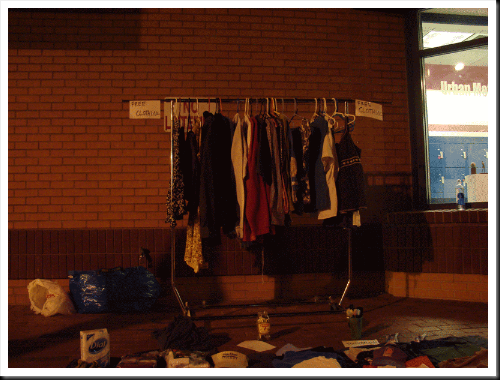
Mill-Ave-Resistance-011

A photograph of the Mill Avenue Resistance clothing rack, the tiny pieces of paper visible on the sides read: “FREE CLOTHING.”


Mill-Ave-Resistance-004

Group shot: Center has some members of the Resistance, Willow and her sign, Barbara, Gadfly, a few others semi-visible; on the right happens to be Al, with Kevin peeking out.
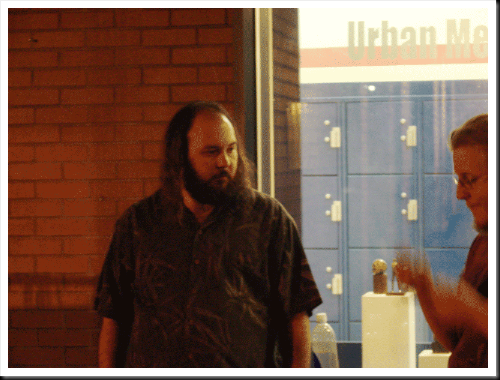
Mill-Ave-Resistance-013

Center: Rocco; Right: Kevin. Not exactly the best candid shot, but I was running my camera in burst mode in order to get some pictures of crowds. In front of the Post Office hanging out and chatting.

Mill-Ave-Resistance-007

This is Marcus standing in front of Al’s crucifix—I really need to interview them at some point about this new phenomena. Marcrus’s crucifix is visible on the left, flashlight strapped to the top. He had it set to “emergency signal” mode so it generated a sort of blinking-rave-light effect.

Saturday, October 09, 2010

Mill Avenue Nights: Friday, October 8th 2010

I hit the red bricks with A and took a trip down to the slowly-filling Tempe Town Mudslick. It’s been taking some extra water from the Salt River via the Hoover Dam and a few other dams that have been opened up, but it doesn’t look to be over a foot of water down there yet.

The Ash Ave bridge looked fairly beautiful anyway. It’s a strangely lit bridge over which the light rail crosses the Salt River (aka the Fake Lake). Lights inside the bridge form a spectrum rainbow when it’s idle, and it switches between a crimson-cyan light pattern when a train passes over it.

Street preachers weren’t much in abundance due to the Second Friday festival out in Mesa—which I heard had some zombies and steampunk cosplayers.

Rainbow Lighting Light Rail Bridge

This is an image of the Light Rail bridge with the rainbow colors in effect, and one more to show off.

Ash Bridge and Etc 079

And this is what it does when there’s a light rail train crossing it. The crimson-cyan colors flow slowly from one side to the other, usually in the direction of travel along with the light rail.

Wednesday, October 06, 2010

Tornados in Flagstaff

tornado1 Not that far from me—well, if you see 150 miles being “not that far away”—some tornados decided to come and play havoc with a town that one of my friends constantly tries to get me to move to. Flagstaff, a city well known for its railroads and snow (and the fact that they’re not far from Sedona and the UFOs) got a licking recently.


The first tornado hit Bellemont — west of Flagstaff — around 5:30 a.m. Wednesday and the second touched down east of the small community a short time later. The third was reported along Interstate 17 just south of Flagstaff around noon.

Fifteen homes in Bellemont were so badly damaged that they were uninhabitable and the estimated 30 people who lived in them were evacuated. Authorities were setting up a shelter at midmorning Wednesday, said Coconino County Sheriff's Office spokesman Gerry Blair.

About 30 RVs were damaged at a business in Bellemont that sells the vehicles and runs a campground for RVs.

Of course RVs! I would be more socked if it hadn’t been a trailer park that drew the maw of doom down upon them.

Point in fact, I was just in Flagstaff not too long ago: Monday. Went there to check things out, kick a few tires, and get rained on—as Gaea herself decided to open the floodgates when I visited. The truth of the matter is that I really enjoy rain, however, I wasn’t driving at the time so I cannot say much for people attempting to navigate the roads.

The thunder and lightning really were something.

I believe that the tornado warning for much of Arizona has come to a close already (5pm today, Wednesday, last I heard.) So stay safe out there.

Link, via the Associated Press.

Tuesday, October 05, 2010

“I like it” Facebook status meme goes viral

breast-cancer-awareness-ribbon_297b Looks like people have struck upon a particularly hilarious viral meme that has a very risqué connotation. Facebook statuses have been popping up all day displaying interesting variations of “I like it…”

I like it on the table.

I like it on the floor.

I like it on the closet.

What does it mean? It’s a reference to where women like to keep their purses. It is part of a breast cancer awareness promotion. According to The Washington Post the “I like it” status has some sort of stupid gender-mystique attached to it in that it’s supposed to be mysterious to menfolk—and this is why its stupid. Really? As if (1) men cannot get breast cancer and (2) as if they shouldn’t also be part of breast cancer awareness and research.

It’s curious, fun, and inventive—just get rid of the vapid nonsense about the boys. Breast cancer affects the entire human race.

Link, via TIME Magazine.

Sunday, October 03, 2010

Mill Avenue Nights: Saturday, October 2nd 2010

I didn’t feel well for most of the night due to an illness brought on my travel, but things got better with a bit of better living through chemistry. At least enough to gather up some of my friends from Mill Ave and parade them around my domain. I got to see Rocco, Steve, Kazz, and Gadfly from the Mill Avenue Resistance. I also got a chance to see some of the street preachers in the form of Al and Tom, and also Marcus (and his new two-planks wooden crucifix—an addition I should interview him about sometime.)

The Mill Avenue Resistance

A no show for most counts.

They appear to have started doing some sort of clothing giveaway involving used clothing and a rack. I haven’t seen the clothing rack yet as it didn’t arrive tonight. They’ve been doing this for a few months now. Mostly attempting to alleviate the needs of the itinerant folk on Mill Ave—an act that I appreciate greatly as the itinerant community of Mill does need a bit of help.

Drum Circle

Gone.

Not a single person appeared during my entire time on Mill. I floated in and out of the area where we usually find that gathering, yet it remained deserted. Perhaps we’ll have to wait a while for the seeds of community to sprout and flourish again. I am still investigating its disappearance.

Interesting events

While Marcus preached from the site in front of the Post Office, I listened to passersby and I noticed that we have a small, but noticeable, contingent of Muslims now—or at least one outspoken Muslim.

“Allāhu Akbar! Allāhu Akbar!” he shouted as he walked past. Cupping his hands to his lips but never turning his head towards Marcus. The well-known exclamation from Muslim culture is known as the Takbīr and translates literally to “God is the greatest!” It is a common Islamic Arabic expression and considered a formal declaration of faith. Extremely similar to the Christian English expression, “Jesus is lord.”

Marcus didn’t appear to notice as he continued on with his usual preaching through his loudspeaker.

The device seemed to have some issues through the night. When I questioned him about that he explained that it had been stepped on drunkenly in a previous outing and now had become temperamental.

Thursday, September 30, 2010

Understanding does not mean what John Reynolds thinks it means

john_mark_reynolds So I just stumbled across this piece by John Mark Reynolds in a recent column in The Washington Post entitled, “Trivia kings, but bad thinkers: understanding over facts.” In which he writes his opinion on the newest of a series of religiously weighted surveys, this one done by the Pew Forum. This recent survey shows that atheists (along with Jews and Mormons) are dramatically more likely to know facts about the religious doctrines of other cultures whereas the religious grade much more poorly. His assertion is that atheists, bolstered by the Internet and books, happen to be good at learning facts but do so without understanding what they’re reading. Thus the title of his piece which boils down of the survey’s results to “atheists are good at trivia.”

He blames the entire society of the United States for having become an entertainment culture where people don’t actually read, spend time ruminating, or actually examine their opinions. As he comments on entertainment culture, he points out that Christians make up a majority of the population yet,

Weirdly, Christians must clean up the mess of broader culture, but we have had little power to create pop culture in the last fifty years. The poor and the disadvantaged are always the first to bear the brunt of bad cultural ideas and only the religious remain on the ground to try to help.

Also weirdly, the poor and the disadvantaged are more likely to be religious, and since “three-quarters or more of the American general population” happen to be Christian... They're more likely to be mostly Christians. So, according to him these bad cultural ideas are coming from a strange minority but being absorbed gluttonously by the Christian majority the very same majority who must “clean up the mess of broader culture.” Something tells me that Reynolds doesn’t seem to get precisely what the word “broader” means.

In this sense it is easier to be an agnostic or atheist. You have rejected the mainstream of American history, which means you don't have to take responsibility for its failures, though you can appropriate its successes.

What the hell is he talking about here? Atheists (and agnostics of both stripe: theist and atheist) don't reject American history as a matter of their atheism or agnosticism in relation to the existence of a god or gods. This sentence sits here all by its lonesome. He cites absolutely no evidence for his assertion and fails to support it with even a single scintilla of rationale. American citizens both suffer the failures of our history and appropriate the successes of it. Perhaps this is a veiled attempt for him to prop up the false notion that the United States is somehow a Christian nation when the Constitution and its supporting documents go out of their way to cultivate a secular government.[1]

Third, we must demand that our government schools teach religion, not just the "facts" but with understanding. Wisdom will only come when we recognize why billions of the world's people believe what they do. This means that majority Christians must also accept charitable expositions of other faiths. When the state of Texas demands less coverage of Islam this is a bad step.

This “understanding” that he’s been crowing through most of this strangely sanctimonious article is actually what the rest of the world would refer to as indoctrination. What’s really odd about this is that he refers to the Pew research and notes how theists fail awfully at knowing even their own doctrine, but claims that they understand their doctrine. He then went winging around about how a person can know a bunch of trivial facts but not understand them; but he really didn’t get around to how precisely a person can have no grasp of any of the facts yet maintain an understanding of a subject nonetheless. After all, that’s exactly how he describes the theists who took the test.

Sure. Teach religion in government schools, but he’s going to be in for a nasty surprise when people realize he’s just basically stated that he wants government schools to teach children to be religious not just about religions.

He will really have to clarify that position before it’s even readable. Certainly he could explain exactly what the difference between knowing that Catholics believe that the communion becomes the actual blood and flesh of their god and understanding that bread and wine turn into bodily fluids and tissue. (This is one of the questions in the survey.)

We must do unto others as we would have them do to us. We must allow students to read books that come from different traditions, from atheism to paganism. The intellectual growth that will result will not be the sort that can be captured in a fill-in-the-blanks or multiple choice exam. Instead, we are going to have to support government school budgets that to allow for small discussion classes that can produce a deeper understanding of important ideas.

We already do this. No special, soppy religious understanding is needed in social studies. Answers are already available with an anthropological context as to why Catholic doctrine includes transubstantiation and the Ancient Greeks believed that their gods rested on Mt. Olympus and sometimes turned people into spiders and skunks. These aren’t even important ideas on the grand scale of living our lives among one another.

For example, one of the most influential books first published by an American is the Book of Mormon. It appears in almost no American government school curriculum, though it exercises a global influence and impacts the lives of millions of Americans. This is foolish. I am, to say the least, no Mormon partisan, but there are entire states in our nation that cannot be understood without some grounding in Mormon thought.

This unsourced claim isn’t for a moment backed up with anything more than mentions of Salt Lake City and Utah. The state is a secular entity due to the force of the Constitution of the United States and while Utah may contain a large number of Mormons, it doesn’t mean the state government gets to run off with their religious convictions in their throats. Utah isn’t some island nation separate and untouched by the rest of the United States. Want to read something extremely influential first published by an American try The Federalist Papers.

Places where he does hit the nail on the head, however, seem to be when he’s talking about trends of anti-intellectualism that seem to be rooted sternly in the austere grasp of American Christian thought. He mentions that Christians “should demand that their churches do more intellectual work.” If only it didn’t seem compelling that this is actually the source of the problem. The Pew Forum survey shows not only that Christians are the worst at knowing basic facts about other religions but they largely know neither their own doctrine’s facts nor could they understand them either (in Reynold’s logic).

He seems to make the weird argument that atheists and non-Christians, according to recent surveys, show better in IQ surveys, general knowledge of culture, and reading level & comprehension because atheists are simply good at absorbing facts. He argues that the intellectual elite reject the religious from their ivy-covered towers, and so forth. When he himself must rail against the brick wall of anti-intellectualism rooted deeply within organized Christianity.

I am not convinced the problem lies where Reynold claims it does.


[1] Salon.com: America is not a Christian Nation http://www.salon.com/news/opinion/feature/2009/04/14/christian_nation

Tuesday, September 28, 2010

TV Review: Chase

chase_nbc_tv_show_logo Here come the blonde warrior women of NBC! The next in my series of television premier series reviews comes Chase. This show reminds me briefly of every law enforcement TV show that has ever existed—but mostly it made me think of In Plain Sight (which I happen to love to death.) Sadly, it doesn’t work quite as well as In Plain Sight does with Mary Shannon as our blonde, quirky protagonist—instead Chase gives us a strong, brass-balled warrior girl in the form of Annie Frost.

And she’s one cool customer.

(What can I say? I’m partial to brass balls archetypical warriors like Vex Harrow.)

I have to admit, I subscribed to this one just because I can feel potential cracking beneath the surface—but it still didn’t manage to keep my attention very well. I found myself drifting out to read stuff on the Internet and edit my articles as I watched. The character drama is lacking and the action scenes are a little lax. However, I must say, they’re humorous enough to make me smile. During one apprehension scene (a chase scene no less) they actually ran through a herd of driven bulls and then crashed through a rodeo in progress. Let me just say, I’d never want to run through a rodeo even if it was just a calf wrangle. I’ve been to the rodeo plenty of times (I’m from rural Minnesota and we had a rodeo every Saturday and Sunday) and with horses and cowboys tearing up the dirt in the arena it was never a safe place to be standing.

Annie doesn’t really have much of an inner life yet. I haven’t been able to get a sense of her or any other character. This is where I think my particular tilt is going to show—I really like portrayals that give me personal access to characters, giving them life and energy outside of the usual on-screen presence. Right now: Annie lacks this. I’d really love to have a half-a-philosopher like Mary Shannon, or the brimming romantic cop, but instead I have a generic law-enforcement type going about her job. Perhaps she’ll grow out of it. I expect her to.

Maybe the show just needs a curious or strange fugitive to take down. Someone that can show me why I should care that our warrior lady Annie Frost has a heart or a grim sense of duty.

And, as a side note, can someone tell me why everyone keeps telling the rookie to hide his gun under his shirt?

Monday, September 27, 2010

Taking a Segway off a cliff: What a way to die

amd_segway_x2 In the news of the dire and strangely sarcastic, the universe attempts its hand at poetic irony. Segway’s owner has died. According to the NY Daily News,

The British businessman who owns the Segway company plunged to his death after driving one of his famous two-wheeled scooters off a cliff, police said Monday.

James (Jimi) Heselden dead at 62—by Segway, precipice, and river, possibly not in that order.

As @AvatarNelson of Twitter fame said, “The owner of the Segway company died driving his Segway off a cliff. This is going to be a PR nightmare for cliffs.

Sunday, September 26, 2010

TV Review: The Event

the-event We’ve seen a bit of an explosion in strange transposition storytelling techniques since Lost became so immensely popular. However, this sort of storytelling always leaves me in a lurch unless there’s a very good reason for it—and Lost really was not. We’ve seen it in stories like Day Break and Flash Forward to better effect. Now there’s a new NBC sci-fi television series to add to the list: The Event.
The pilot introduces us to two separate story arcs that still appear to be disconnected. In one of them a character named Shawn Walker who happens to lose track of his girlfriend (she mysteriously disappears.) While there’s the “leader” of some unknown and vague sect of people visiting with the President of the United States—the sect also seems to be currently detained in a Guantánamo-style facility in the blinding white north of artic Alaska. Who they are or what they’re about is left totally undisclosed.

The plot is revealed almost entirely in unfettered flashbacks. “8 hours ago,” “23 days ago,” so on and so forth. It does form a cohesive narrative, but it’s headache inducing in that it’s spends all of its time in flashbacks and none of it forming the current narrative. Although the first thirty seconds and the last thirty seconds are the current time.

The story begins with a news broadcaster screaming that the ground is shaking and then we see an aircraft flying very slow—presumably about to crash into the Presidential manor where he’s meeting with the leader of the mysterious detainees.

I subscribed to this one merely because it contains an extremely powerful sci-fi element that’s rather inescapable from the end of the first episode. To reveal that, however, would be a massive spoiler. Although, it was extremely tedious to watch the show up to that point.

Can this show probably save itself from becoming another punctuated dramatization soap opera like Lost?

It’s very likely.

However, it seems to me that it really just wants to hook the viewers with these manufactured mysteries that are developed now out of natural investigation but flashback storytelling—always keeping the viewer out of the loop so that they can’t grasp the moment. It’s a little bit insulting to me as a viewer. This is not Memento.

The show’s producer has promised that future episodes will use flashbacks more for character development than plot development but I’m almost too far gone to care at this point. As long as it doesn’t fall down the ever deepening rabbit hole that Lost found itself creeping through (but never reaching Wonderland) we might have a good deal in this show.

Saturday, September 25, 2010

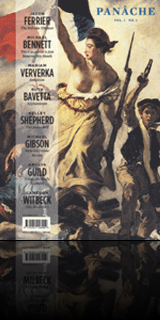
Recently published in the Premier Issue of PANÂCHE Autumn 2010

panache My short story “Meet the Pricers” has been published in the premier issue of PANÂCHE Journal of Poetry & Fiction: Volume 1 Issue 1 Autumn 2010.

“Meet the Pricers” is a short story set at a Goodwill store in Phoenix, Arizona—which just happens to also be the center of all Goodwill stores in the universe. Cammy, who happens to work a register, finds herself in an unexpected adventure when a customer brings a pair of socks to the front that lack a price tag.

An electronic subscription to the journal only costs $35.00 USD ($55 for print). People who buy a subscription now will receive the current issue (and presumably future issues, but it doesn’t say for how long). Although, there is no news yet if individual issues can be purchased.

Curious enough, the publisher of this journal is also in Michigan (where I am staying right now.)

Find PANÂCHE on Twitter and at Facebook.

Friday, September 24, 2010

TV Review: Lone Star

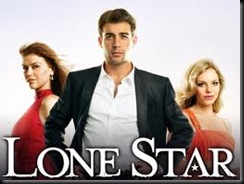
lonestar So we’ve got a new crop of television shows clangoring for my attention on Hulu and, just to be polite, I’ve started watching them. As a result, I’m going to review them to see what I thought of each one, and how I felt about them. Lone Star, a drama created by Kyle Killen, portrays the strange life of a con man and his father. Although the premise really strikes me as interesting—I certainly love con man shows and movies like Matchstick Men and White Collar—the pilot failed to hold my interest for very long.

The story sets itself up as the child of possibly the biggest con man in the industry, Robert Allen, works his way through the blue collar and white collar elite alike by bilking them of their hard earned money through selling them snake oil prospects (literally nonexistent energy prospects in oil rigging.) To produce additional drama, he’s running a split con that requires him to keep two separate lives—demonstrated by carrying two separate phones and address books with him. In one life he’s married to a billionaire energy tycoon’s daughter, and the other he has a lovely girlfriend. Both of them don’t know about the other.

Slowly but surely his oil-rig con begins to bleed out as he goes state-to-state seeking would-be investors into the project. Except that there’s no actual holding for them to invest in, so he’s going to have to vanish eventually. Of course, the ties that bind come into play pretty quickly as he happens to like his girlfriend from the oil-rig con and he will one day have to leave her in the dust when he had to quit his hunting grounds if he gets found out.

On the other angle, he seems to be attempting to get into his wife’s family business through her father by getting a job there and then swindling the company out of its vast finances—presumably through some sort of embezzlement. Except this is where things go sideways for his own family business (which happens to be the con) a he decides that he’d rather take this new 7-figure job instead of bleeding the company dry. A fact that his father doesn’t take too well as he’d rather not have his son quit the family con business to take up the mantle of a real energy financier and investment broker. A job that Robert is surprisingly talented at due to his many years tricking people into thinking that he owns a stake in oil and gas drilling.

The real heart cinch of the story that got me happened to be some of the characterization of his father and his own love life—especially how he juggles a girlfriend and a wife.

In one scene, he is propositioned for a one-night-stand by a girl in a hotel lobby who fancies him and invites him back to her room. She gives him a long, convincing argument as to why she should be able to take him to bed and his wife shouldn’t have to know about it. This after Robert first subtly hints, then directly promotes the fact that he is in fact married. At the end of the conversation the woman asks him if he could give one good reason why he couldn’t. And he tells her that he could give her two good reasons. The implied undercurrent here happens to be that those reasons happen to be his wife and girlfriend (between whom he’s cheating on each with the other.) An interesting fact for him as he chooses to keep his fidelity to them, even if they don’t know about each other.

The big spoiler for this episode lays here.

At the very end of the pilot, and near the point where I’d already lost interest, he had a final fight with his father. He’s been found out in his oil-rig scam and has to get out—a fact that means he has to leave his girlfriend behind. Something he doesn’t want to do. His father berates him viciously for forgetting to play his part, pretend to be a character, and not get personally involved in his con. As every con must end and there’s no reason for him to break his own heart while breaking the heart of the girl. However, he’s gotten too involved with his girlfriend. Instead, he finds a way that he can maintain his double life even with danger breathing down his neck.

“Because, Dad, I’m in love.”

“With which one, son?” his father asks. “The fake girlfriend or the fake wife.”

“Both.”

It’s cute, but in the end I’m not as interested in the direction that Robert’s life is taking. It’s keen enough that he has this con going on. His wife’s father is extremely scary and menacing but trusts him honestly. He does life this double life that could fall apart at any moment. But, I don’t know that I want to see where it goes.

I didn’t subscribe to it on Hulu, so I won’t likely be watching further episodes unless one catches my eye.

Thursday, September 23, 2010

Facebook Denial of Service Attack

Update: Okay, this was a little stupid: the apparent DDoS against Facebook today, the Wired article that I found is from 2009 and I misread the date (thought 09 meant September.) Looks like what happened was an internal database snafu. Here’s a CNET article on the subject.

facebook Looks like Facebook is currently down due to a denial of service attack. While it’s been marked as “they were the victim of an attack [this] Thursday morning,” it’s still ongoing and it’s almost 1pm now.

“Earlier this morning, Facebook encountered network issues related to an apparent distributed denial-of-service attack, that resulted in degraded service for some users,” responded Facebook spokeswoman Kathleen Loughlin via e-mail.

We’ve seen this happen before with Twitter—and if it’s the same people who did that, someone wants Facebook offline today. I don’t know yet if Twitter is getting hit with the same DDOS at the same time or if this is simply targeted at Facebook without mangling Twitter.

If anything, it’s a pretty powerful DDOS to wipe out something like Facebook as they already absorb a lot of traffic; then again, that might make them more vulnerable. In the future of cyberwarfare, taking out distributed media-discussion on the Internet will be a useful component when governments and countries want to do things under cover of darkness. Of course, they’ll have to take out more than just Facebook and Twitter to actually make a dent.

Here’s looking forward to it reappearing later today after they get themselves sorted out. I will link the postmortem.

Link, via Wired.

Wednesday, September 22, 2010

Elements: Water

I am suddenly reminded of my great love of marine biology—although, the truth of the matter is that I hate fish. When I studied marine biology, I kept most of my adoration for the invertebrates: give me a sea cucumber, a jellyfish, a crinoid, or something similar over a fish. Please. The ocean is teeming with everything imaginable, but for some reason fish never really gave me much pause. The vast variation of other creatures, large and small, provided more than enough amazement for me.

Most of our planet is covered in it.

Its glittering blue provided not because of some refraction of water itself, but in most cases simply the reflection of the sky. At sunset the oceans become painted with a wash of gold and red; and at night, they betray no color, perhaps except the hushed green of bioluminescence tipping the waves as they crash in the surf.

Water will display prominently when I write the stories of the Helljammer series—a story mostly about naval engagements, pirates, zombies… You can’t have good pirate stories without lots of water. Unrelenting waves of blue, cast against open and clear skies, from horizon to horizon, but for the ports we visit to regain supplies.

Without water, we wouldn’t have piracy on the high seas. So I’ll thank it for that.

Water doesn’t show up so much in SciFi, relegated to the terrestrial worlds—or worlds that are entirely water themselves, like Europa, if simply covered in a layer of ice. Alien planets, perhaps, but not the spacers. They do depend on it, to an extent, but given enough power it’s possible to just tell an oxygen and two hydrogen to produce a water molecule, and form there it’s just a matter of doing that a billion times.

Water shapes the world.

Neither earth nor fire stand up to water. Water is patient. Mountains rise up, water wears them down. The slow, driving course of rivers carves out great swaths like the Grand Canyon; and perhaps it did the same on Mars—the arid world showing evidence of once perhaps having its fill of liquid water.

Water. It’s what’s in my drinking glass right now.

An excellent suspension for syrup and caffeine.

Monday, September 20, 2010

Millvexations.com lives again

That is all.

http://www.millvexations.com

(The problem occurred due to a dedicated IP address. It is resolved now.)

“The Academy” A. Barnes’s dirty, raw still-growing up ‘X-Men like’ serial

I’d like to introduce everyone to The Academy, which is a brand new serial fiction story written by A. Barnes who is probably looking for a few readers and maybe a proofreader. His first chapter was published none-too-long ago and includes a series of characters designed and offered by his friends on Facebook.

It’s a spit-polished work of love that represents the mainstay of new writers.

My claim to fame in this new story? Jessika, the first character introduced, is the one that I came up with for his story. She, like the other supers on the transport at the beginning, has some issues with her powers that she wants to get control of—namely, she’s capable of controlling her density at a molecular level. The only problem? Her stress levels affect her control. When she stresses, she becomes more dense, often to the point of cracking the floor (or flattening her chair) and when she’s too calm she can become insubstantial and float away.

He’s very rough around the edges, so don’t expect Hemingway; but that’s barely a reason not to engage. Even if you only stay for two chapters (there’s only two right now) you can still leave your mark, some encouragement, and perhaps part of a constructive critique.

All new writers can use a little bit of a heave-to from the rest of us.

Start reading The Academy at Chapter One.

Sunday, September 19, 2010

Millvexations.com currently down

http://www.millvexations.com 

My wonderful hosting company just migrated our IP addresses but unfortunately my sites didn’t migrate with it; I am currently waiting for the website for Mill Avenue Vexations to catch up. (It is currently showing a default page instead of the proper start page.)

In the meantime, you could read the opening letter for Helljammer or catch up on Black Hat Magick (which run on a separate host.)

Interestingly, ProjectWonderful hasn’t noticed that it’s down yet, so it might just be displaying this to me (for some unknown reason) so I am hoping to see if other people are getting the same sort of reaction from their web browsers when they visit. Otherwise, I am letting their technical support troubleshoot the issue.

Wednesday, September 15, 2010

Elements: Fire

I am reminded of the words of Vex Harrow from The Holocaust Star,

A lot of people say that the world will end in fire; I’m not about to tell you that I know how it all ends—but I can say one thing for sure: it started with fire.

The ancients of every people loved the flame, and they already feared it. Prometheus brought fire as a gift and Coyote got burned trying to steal it. The Hawaiians say Ai-Laau, the forest eater, ruled Kilauea until Pele chased him off. My da says there is fire in whiskey that fuels the soul. As for me, I’ve got just four things to say about fire: it’s pretty when you keep at a distance, it’s a good friend when you’ve got a way to put it out, a terrible master when you screw up, and a savage enemy when it turns on you.

People are so hooked on fire that when we die we expect to find it blazing on the other side. Sometimes people strap themselves to the pyre to get a head start. Other times we burn sacrifices to purify them, which brings me to my own, albeit short, fiery interlude.

Fire has so much mythology behind it that it has a life of its own in every culture. It is nearly the first technology—the ultimate protector and destroyer. It enables us to live in places without light, with little heat of their own, to pass survival through the dead of winter under its blazing fingertips.

In modern day, as well as Scifi, we could see fire as the embodiment of the nuclear fires that give life to our sun. The underlying power that lives within the atom, when unleashed, fans the flames of war and devours entire cities as the case of Hiroshima and Nagasaki. But that same fire, like all fires, when held in check can power entire cities, or raise nations out of the dust of mediocrity.

Electricity from fire, it’s the same infrastructure that enables me to tap keys to keyboard and write this trite prose right now.

Wednesday, September 08, 2010

Elements: Earth

Foundation. Stone. Rock. The unmoving ground. While the element earth contains a great deal of different connotations for many cultures—and some even eschew it from their lists of elements for other compounds—it is still the source of many of our raw materials. Earth: the container of all life.

We build our dwellings from it. We build them upon it. It comes in many forms, from the solidity of rock, to the trembling uncertainty of peat bogs. It gives rise to trees that stretch above it, roots that dig beneath, and provides the matrix for which all things mount themselves against the sky.

In the creation stories of many mythologies the earth is the first place—and from it all life is formed. From the earth all living things rise, and to it they decompose when they are done. The ultimate and final configuration of star-stuff that gives a place to stay, provides food, shelter, and all the comforts of life.

In Scifi stories, earth is the element of planetary bodies. The primary difference between spacers and terrestrials. Even alien worlds have all the makeshift necessity of earthiness—in fact, we could argue easily that even Mercury has “earth” although it is an airless, lifeless world it is only earth and nothing else. Spacers find it by taking small chunks of it in the form of asteroids, or necessarily learn to live with much less of it by producing food with hydroponics. The spacer and the terrestrial will, however, possibly argue about the merits of cold steel and artificial gravity, or gravel and the planetary weight of natural gravity.

Earth. It’s even the name of our home world.

It’s the calling card of modern day environmentalists. The body of the Goddess made manifest—the life-giver.